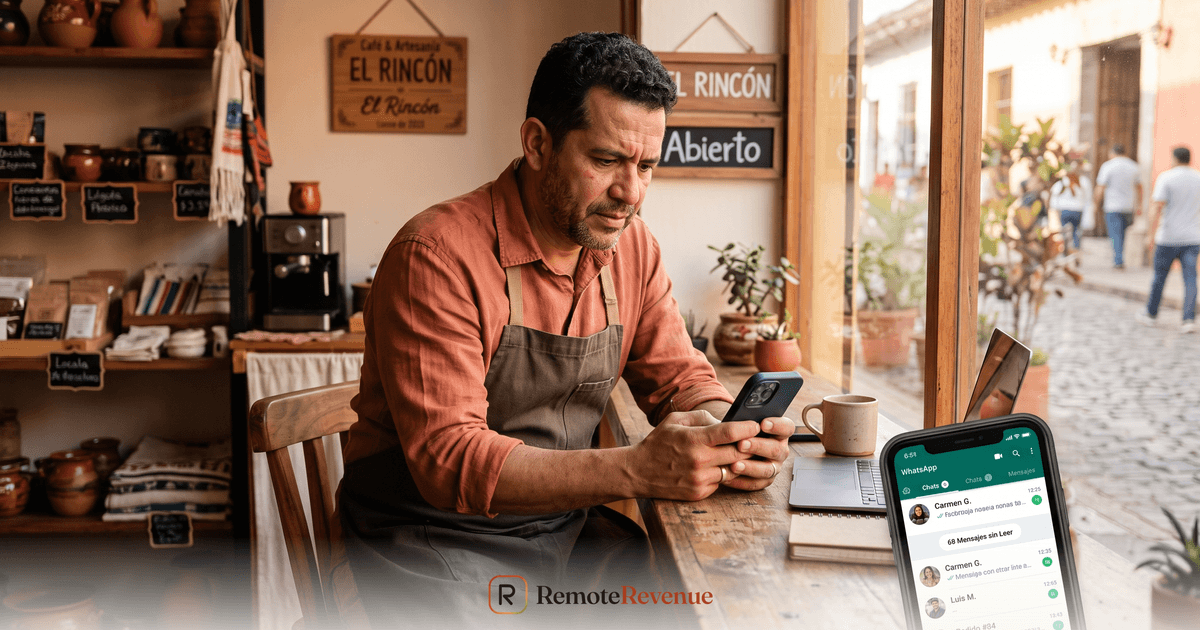
What the Highest-Selling Businesses Are Doing Differently in 2026

Every year a new list of "sell more" trends shows up. New platforms, new content formats, new buzzwords. But when you look closely at local businesses that genuinely grow year after year, the pattern that repeats has nothing to do with any trend. It has to do with something much simpler: what they do with every person who's already writing to them.
They don't compete with more advertising, they compete with more follow-up
It's tempting to think a business sells more because it spends more on ads. Sometimes that helps, but it isn't the main difference. Two businesses can spend exactly the same on advertising and get very different results, and the difference almost always comes down to what happens after the click: who responds, how fast, and how well that person is guided until they decide.
The businesses that sell the most understood that every dollar spent attracting someone is wasted if that person doesn't get a timely reply or goes cold along the way. That's why they invest as much (or more) in organizing follow-up as they do in attracting new people.
They treat every message as an opportunity, not an interruption
There's a difference in attitude, not just process. In a business that hasn't organized its follow-up, a message arriving mid-afternoon feels like a distraction from whatever was already happening. In a business that has, that same message already has a defined place: someone or something receives it, sorts it, and starts a reply, without anyone having to drop what they're doing to avoid losing it.
That difference in attitude shows on the customer's side. A fast, clear reply communicates something, even if no one says it out loud: you're going to be taken care of here.
They use AI for the repetitive part, not to replace human interaction
A common mistake is thinking automation means replacing people. The businesses doing this best use artificial intelligence the opposite way: to take repetitive tasks off their plate (answering the same questions, sending the first message, scheduling a reminder) and free up more human time for conversations that genuinely need judgment, empathy, or negotiation.
AI answers fast and tirelessly the fifteen people asking the same thing about hours or pricing. The team member is left with conversation number sixteen, the one that needs more than an automated reply.
They measure what used to be left to gut feeling
Another notable difference is that these businesses know, with some precision, how many people wrote to them, how many are still in the process, and how many ended up buying. It isn't a complicated report, often it's just a simple spreadsheet updated daily. But that visibility changes everything: it lets you see where people are being lost before it becomes a big problem, and decide with data instead of a hunch.
The pattern repeats across any industry
This pattern doesn't depend on the industry. It looks the same in an aesthetics business, in a real estate agency, in a professional services firm, or in any local business that gets inquiries over WhatsApp or social media. What changes is the type of question or how long the decision takes, not the underlying logic: reply fast, don't let the second contact die, measure what's happening.
A simple example to see it in your own business
Take any normal day in your business and count how many people wrote to you. Of those, how many did you reply to the same day? Of the ones who didn't buy right away, how many did you write to again the following week? Most business owners have never asked themselves these questions with real numbers, which is exactly why it's so common to underestimate how much is being lost simply by not closing that loop. You don't need a sophisticated system to start, you need to start counting.
Once you have those three numbers (how many write to you, how many you reply to the same day, how many get followed up with afterward) you already have a more honest read on which part of the process makes your business look like the top sellers, and which part doesn't yet.
If you want to see this pattern applied to a real case, this case of a fertility clinic that stopped losing patients who asked questions and never booked walks through it step by step, including why follow-up in that kind of business requires more care than in others.
The question worth asking isn't which trend to follow this year, but how well you're treating the people who are already writing to you today.
Want to see the gap in your own business?
Book a free 20-minute diagnosis and we'll look together at how close or far you are from this pattern.