What an AI Sales Funnel Is and How to Apply It Without Being a Tech Company
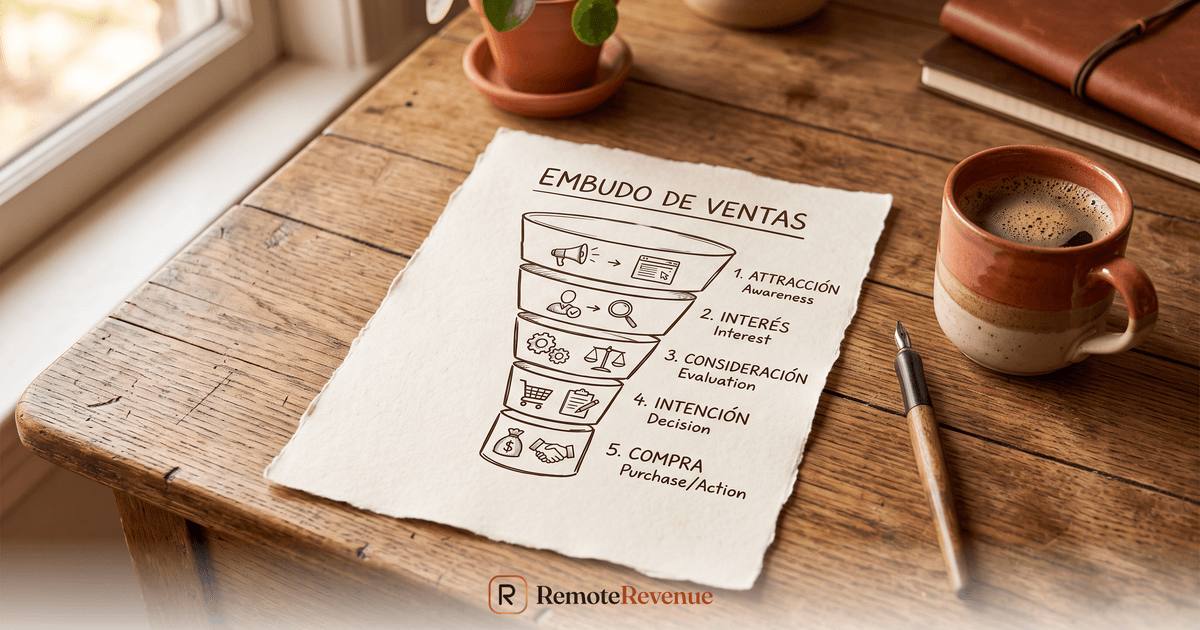
The phrase "sales funnel" sounds like something only big marketing companies use. In reality it describes something much simpler, that already exists in your business whether you know it or not: the path someone follows from finding out you exist to buying from you. The only real question is whether that path is organized or left to luck and whoever happens to be answering.
What a sales funnel actually is
In its simplest form, a sales funnel has three moments: someone finds out about your business and shows interest (they write to you, ask a question, fill out a form), someone talks with that person and answers their questions, and someone closes the sale or the booking. The word "funnel" comes from the fact that, naturally, not everyone who enters at the first step reaches the last one. What separates a business that sells well from one that doesn't isn't keeping the funnel from narrowing (that's normal), it's keeping it from narrowing for avoidable reasons: no reply, no follow-up, incomplete information.
Where AI fits into each stage
At the first stage, when someone first asks a question, AI can reply instantly with real information about your business, without that person waiting hours to know if it's worth staying interested. At the second stage, when repeated questions need answering (ballpark pricing, duration, availability), AI can handle the most common ones and leave the conversation ready for a person to step in and handle whatever genuinely requires judgment. At the follow-up stage, when someone doesn't decide right away, AI can trigger the second and third contact automatically, at the right moment, without depending on someone remembering.
What AI shouldn't do
There are parts of the funnel that should stay human, and it's important to be clear about this. Closing an important sale, handling a delicate objection, deciding on a price exception, or managing a complaint: all of that requires judgment and a human touch. AI isn't there to replace those conversations, it's there so they reach the right person with the context already resolved, instead of getting lost in repetitive tasks before getting there.
It's worth repeating because it's where most businesses get it wrong: automating the human touch at the exact stage where human touch is needed produces the opposite of the intended effect. The customer notices, and what was supposed to be a smooth experience feels cold right when it matters most.
How this looks in an average business
Picture a service business that gets twenty inquiries a week. At the first stage, AI replies to all twenty instantly with basic information. Of those twenty, fifteen have repeated questions that AI also answers (ballpark pricing, availability, what's included in the service), leaving those conversations ready to book. The remaining five have more specific questions and go straight to a team member. Of the twenty, maybe only eight book in the first week; the other twelve enter a scheduled automated follow-up, and some of those reactivate weeks later thanks to follow-up that otherwise would never have existed. That is, in essence, a funnel working: no one gets lost simply because there was no one to write back.
The basic metrics worth tracking
A funnel, to be improved, needs some measurement. It doesn't require a sophisticated dashboard: it's enough to track, even in a simple spreadsheet, how many people come in each week, how many reach the booking or closing stage, and how many fall away at each intermediate stage. With those numbers, even approximate ones, you can clearly see where the biggest loss is concentrated, and that's exactly where the next fix should focus. Without that visibility, any change you make is a blind bet.
When it's not worth automating yet
If your business gets few inquiries a week and your team handles them well without any special effort, automating right now probably won't bring a real benefit, just unnecessary complexity. An AI funnel pays off once the volume of contacts already exceeds what can be handled well manually. Before that point, the most valuable thing is usually just organizing the process with the simplest tools possible, and saving automation for when the volume justifies it.
How to start with the bare minimum
You don't need to automate the entire funnel at once. The most practical approach is starting with the point where you're losing the most today: if the problem is slow replies, start there. If the problem is that no one follows up after the first contact, start there. Automating a whole complex funnel before you've identified your main leak tends to be wasted effort.
If you want to see a concrete example of a single piece of this funnel working well, this case of a medspa that reduced its no-shows with automated reminders explains how it was implemented, starting with the most painful point before touching the rest.
Want to see what this funnel would look like in your business?
Book a free 20-minute diagnosis, no technical jargon.